
- Home
- IT Services
- AI Video Analytics & Intelligent Video Systems
- Savant Home Automation
- Help Desk & Maintenance
- Advanced Networking Security
- Audio Visual Installation
- Moves, Adds and Changes
- Structured Cabling & Networking
- VoIP Installation in NYC
- Smart Home Automation Systems in NYC
- Audio Video NYC
- Media Room & Home Theater Installation in NYC
- Audio Video Structured Cabling NYC
- Security & Surveillance
- New Construction
- Area
- Brooklyn, NY
- Queens, NY
- Home Security Services NYC
- Home Security Services New Jersey
- Manhattan, NY
- Audio Video Downtown Manhattan
- Audio Video Midtown Manhattan
- Audio Video Midtown
- Audio Video Upper East Side
- Audio Video Lower East Side
- Audio Video Uptown Manhattan
- Video Camera Installation in Murray Hill, Manhattan, NY
- Video Camera Installation in Chelsea NY
- IT Help Desk Support Queens, NY
- Home Automation Installation Queens, NY
- VoIP Phone Systems Installation Manhattan, NY
- CCTV Camera Installation Bronx, NY
- Access Control Systems Queens, NY
- Structured Cabling Installation Manhattan, NY
- Network Security Services Brooklyn, NY
- News
- Projects
- Contact
NYC Audio Video & Security Installer Guide (2026)
If you’re a New York property owner or business operator searching for an audio-visual, security, or smart-home installer in 2026, the decision is significantly more complicated than it was even five years ago. The technology stack has converged. CCTV systems now run on the same network as your phones. Conference room AV depends on the same Wi-Fi as your point-of-sale system. Access control is no longer a standalone product, it’s a cloud platform that touches your IT infrastructure, your video surveillance, and your visitor management.
That convergence has created a problem: most New York installation companies are still organized the old way. The CCTV company doesn’t really do AV. The AV company doesn’t really do networking. The IT company doesn’t touch low-voltage cabling. And the homeowner or business owner ends up managing four different vendors, three different invoices, and zero clear accountability when something breaks.
This guide is designed to help New York property owners, particularly in Manhattan, Brooklyn, Queens, Murray Hill, the Upper East Side, and Midtown, make a smarter decision when hiring a single installation partner for AV, surveillance, structured cabling, smart home automation, and IT services.
The State of NYC Installation in 2026: What’s Actually Changed
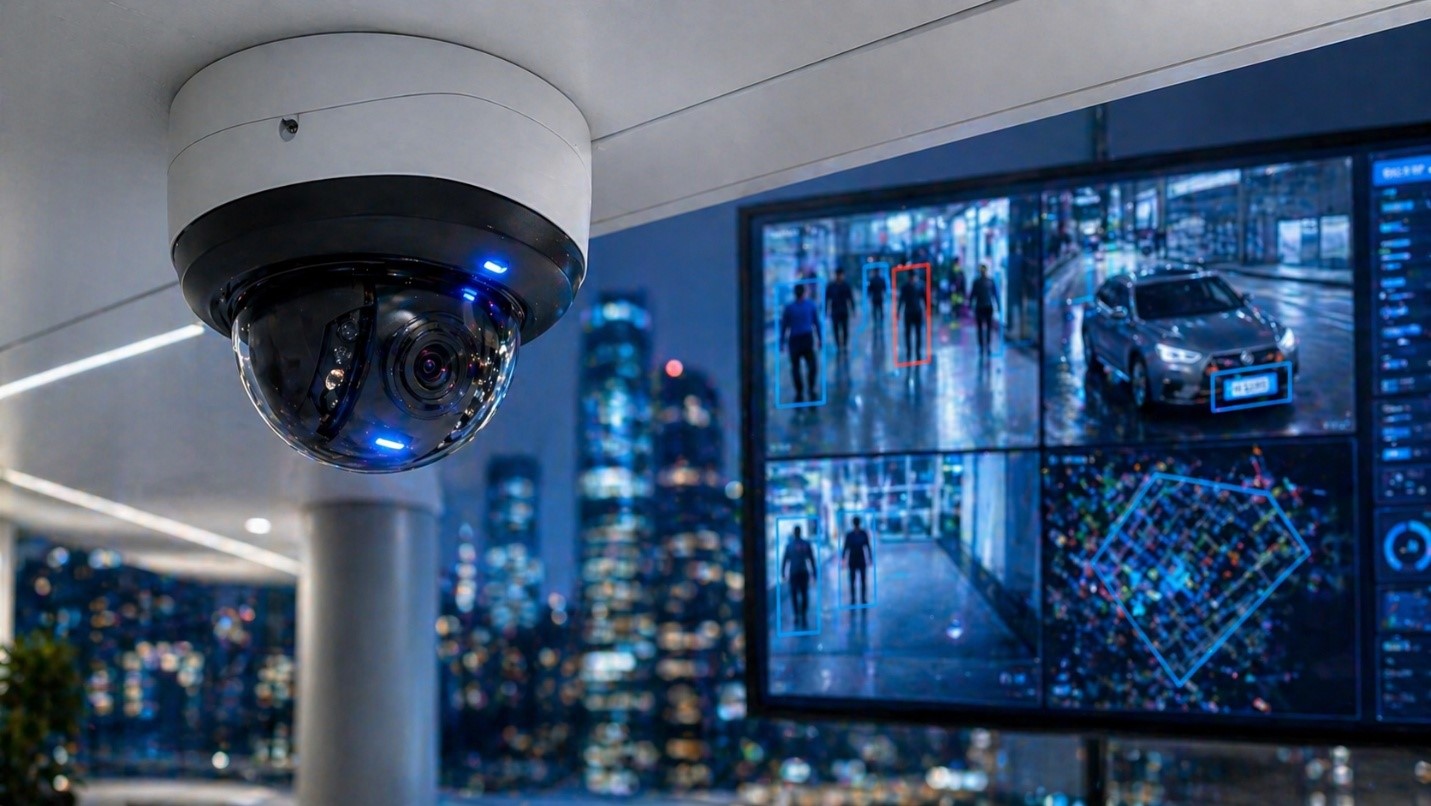
Three shifts have fundamentally changed what a “good” AV and security installer looks like in New York:
1. AI video analytics is now table stakes. Cameras that simply record video are no longer competitive. Modern surveillance systems perform license plate recognition, people counting, motion-zone alerts, intrusion detection, heat mapping, and intelligent search across hours of footage. Any installer who is still selling 2018-era DVR systems with passive recording is selling you something that will be obsolete within 24 months.
2. Cloud-based access control has replaced traditional alarm panels. Brivo, Verkada, Avigilon Alta, and similar platforms have moved access control off-premise, which means the installer needs to understand cloud architecture, mobile credentials, and integration APIs, not just how to wire a magnetic lock.
3. Smart home and commercial AV have merged into the same skill set. A Savant home automation install in an Upper East Side apartment uses the same Crestron-adjacent control logic as a Zoom Rooms conference deployment in a Murray Hill office. Installers who specialize in only one or the other are increasingly behind.
The implication: the right installer in 2026 is one who can speak fluently across IT, AV, surveillance, networking, and smart automation, and who has the in-house team to execute all of it.
The Six Service Categories That Matter Most
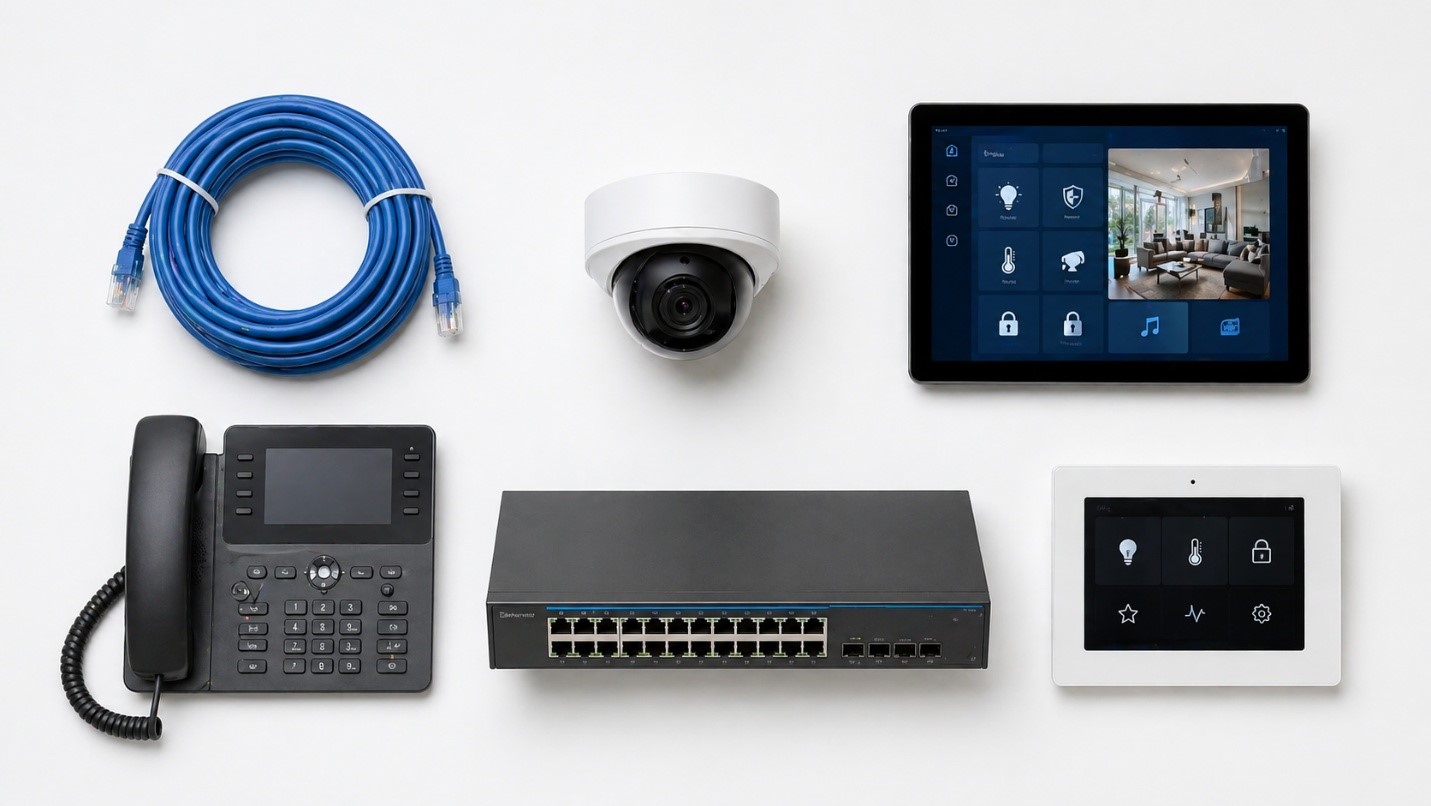
Before evaluating any installer, decide which of the following six service categories your project requires. Most NYC properties, residential or commercial, need at least three.
Audio Video Installation
This category covers conference room AV (4K displays, video conferencing, wireless screen sharing), commercial digital signage, distributed audio systems, and home theater installation with surround sound and acoustic treatment. In NYC, the constraints are usually physical: pre-war ceilings, concrete floors, narrow conduit paths, and co-op board approval requirements all influence installation design. A serious AV installer in New York will conduct a proper site survey before quoting and will design around the building rather than fighting it.
Surveillance & Security Systems
CCTV, IP cameras, NVR/DVR systems, AI video analytics, video intercom, and alarm systems. The right installer will recommend IP cameras over analog (60x better resolution, plus support for motion detection, audio detection, and tampering alerts), will specify proper PoE-grade cabling, and will integrate the surveillance system with access control and alarm panels rather than treating them as separate islands.
Smart Home Automation
This is where Savant, Crestron, and similar platforms come in. A proper smart home install integrates lighting, motorized shades, climate, audio, video distribution, security, and entertainment under a single mobile or in-wall interface. In NYC luxury residential, particularly the Upper East Side, Tribeca, and Manhattan brownstones, Savant installation has become the de facto standard for high-end clients who want one app to control the entire residence.
Structured Cabling
Cat6, Cat6A, fiber optic, low-voltage cabling, and patch panel termination. This is the foundation layer for everything else. New construction projects, gut renovations, and office buildouts all require professional cabling design before any AV, surveillance, or networking equipment is even ordered. Any cabling work in NYC requires familiarity with NYC building codes, fire-stopping requirements, and union vs. non-union job site rules.
IT Help Desk & Network Security
Day-to-day IT support, server maintenance, firewall configuration, managed switches, secure Wi-Fi deployment, endpoint protection, and HIPAA-compliant network design for medical and legal clients. For commercial clients in NYC, this is increasingly bundled with AV and surveillance because the same team is already on-site managing the network that everything else runs on.
Cloud-based phone systems with auto-attendant, voicemail-to-email, multi-site extension dialing, call recording, and CRM integration. VoIP has effectively replaced legacy PBX systems in NYC commercial environments, but only when paired with a properly configured network that supports QoS for voice traffic.
Neighborhood-Specific Considerations
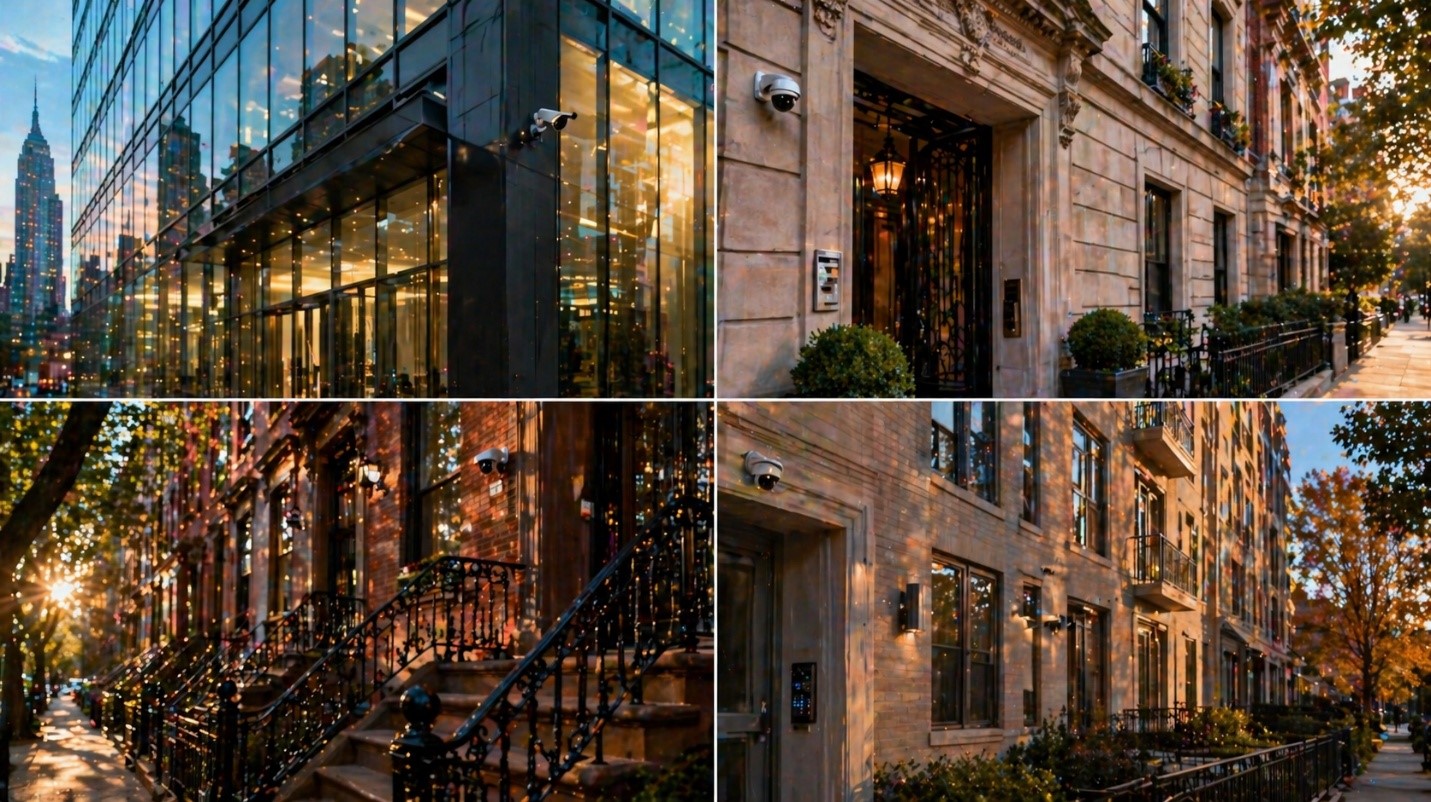
NYC is not a uniform installation market. The right approach varies meaningfully by neighborhood and building type.
Midtown Manhattan & Murray Hill
Predominantly commercial. Office buildouts, conference room AV, structured cabling, VoIP, and managed IT dominate the workload. Building management companies and union site rules often apply. Same-day response capability matters because conference room AV failures and CCTV outages happen at corporate offices that cannot afford operational downtime.
Luxury residential. Savant home automation, distributed audio, home theater, video intercom upgrades for pre-war buildings, and discreet camera installation that respects architectural detail. Co-op board approval and fully insured installers (typically $2M minimum liability) are non-negotiable.
Lower East Side & Downtown Manhattan
A mix of residential lofts, restaurants, retail, and creative offices. AV, surveillance, and Wi-Fi deployment in older buildings with limited conduit access. Restaurants in particular need POS integration, surveillance for loss prevention, and reliable Wi-Fi for guests.
Brownstones, multi-family buildings, restaurants, and a growing creative-office market. Common projects include video intercom upgrades, residential CCTV, AV installation in renovated brownstones, and structured cabling for new commercial buildouts in DUMBO, Williamsburg, and Downtown Brooklyn.
Multi-family residential, light industrial, retail, and a heavy concentration of medical and dental practices. CCTV, access control, video intercom, VoIP for medical offices, and HIPAA-grade network security are all in high demand.
Red Flags: How to Identify a Weak Installer Before You Sign
These are the warning signs that a NYC installer is going to cause you problems:
1. They quote without a site survey. If a CCTV, AV, or cabling estimate arrives based on a phone call alone, the number is fictional. You will be hit with change orders the moment work begins.
2. They subcontract the work they claim to do. Ask directly which portions of the scope will be handled by their employees versus a subcontractor. Subcontracted work is fine for specific specialties (electrical, sometimes fire alarm), but if the camera installation, AV mounting, and cabling are all going to different companies, you don’t have one accountable vendor, you have three.
3. They cannot produce a current certificate of insurance. Most luxury Manhattan buildings, co-ops, and commercial property managers require $2M+ liability coverage to even allow a vendor on-site. If the installer can’t produce a COI on request, they are either uninsured or work primarily on small-scale residential.
4. They sell only one brand. Installers who push only one camera manufacturer, one AV brand, or one home automation platform are usually trying to maximize their margin rather than design the right system for your property. A serious installer is brand-agnostic and recommends equipment based on the use case.
5. They cannot answer integration questions. Ask: “How will the access control system talk to the surveillance system?” “How will the conference room AV authenticate against our network?” “How will the alarm system trigger camera recording?” If the answer is vague, the installer doesn’t actually understand integration.
6. No emergency response plan. Things break. CCTV systems go down. AV equipment fails before client meetings. A serious installer has a documented response process and can dispatch a technician within hours, not days.
What a Properly Integrated NYC Installation Looks Like
To make this concrete, here is what a real, properly executed NYC commercial installation should include:
A 30-person Murray Hill law firm engages a single installer for a full office buildout. The scope includes:
- Cat6A structured cabling throughout 8,000 square feet of office space
- Three conference rooms equipped with 4K displays, ceiling microphones, Zoom Rooms integration, and wireless screen sharing
- 14 IP cameras with AI video analytics covering reception, hallways, file rooms, and entry points
- Cloud-based access control with mobile credentials for 35 employees
- Cisco-grade managed switches, business-class firewall, and secure Wi-Fi with separate guest and employee networks
- 30-station VoIP phone system with call recording and voicemail-to-email
- Ongoing managed IT and help desk support with documented response SLAs
A single installer with the right team handles all of it on a coordinated timeline, with one project manager, one invoice structure, and one accountability point. This is what a 2026 NYC installation should look like and why the old model of hiring four separate vendors is increasingly obsolete.
Why NYC IT Tech Was Built for This Market
NYC IT Tech operates from 286 Madison Avenue in the heart of Midtown Manhattan and serves clients across Manhattan, Murray Hill, the Upper East Side, Lower East Side, Chelsea, Downtown Manhattan, Brooklyn, Queens, and the Bronx, with the specific operational model described above.
The company was structured from the start as a full-stack technology integrator rather than a single-discipline installer. The same in-house team that runs Cat6A cabling for a new-construction office in Murray Hill will also configure the firewall, install the managed switches, mount the conference room AV, commission the surveillance cameras with AI video analytics, and stand up the VoIP phone system. For residential clients on the Upper East Side or in Brooklyn brownstones, that same model applies to Savant home automation, home theater installation, distributed audio, video intercom systems, and integrated security.
Service Capability at a Glance
| Service Category | NYC IT Tech Capability |
| Conference Room AV Installation | Full design, install, and integration with Zoom Rooms, Microsoft Teams, and Google Meet |
| Home Theater Installation | Dolby Atmos surround sound, 4K/8K projection, acoustic design |
| CCTV & Surveillance | IP cameras, NVR systems, AI video analytics, license plate recognition, people counting |
| Savant Home Automation | Certified Savant integration of lighting, shades, AV, climate, security |
| Video Intercom Systems | Multi-family residential and commercial intercom design and installation |
| Commercial Security Systems | Access control, alarm systems, integrated CCTV for offices, retail, and medical |
| Structured Cabling | Cat6, Cat6A, fiber optic, new-construction pre-wire, low-voltage subcontracting |
| IT Help Desk Support | Remote and on-site help desk, server maintenance, moves/adds/changes |
| Network Security Solutions | Firewalls, managed switches, secure Wi-Fi, HIPAA-compliant network design |
| VoIP Phone Systems | Cloud VoIP with auto-attendant, call recording, multi-site extensions |
| New Construction Services | Pre-wire, site surveys, fully insured cabling subcontracting |
Coverage Areas
Manhattan (Midtown, Murray Hill, Upper East Side, Lower East Side, Chelsea, Downtown, Uptown), Brooklyn, Queens, the Bronx, and parts of New Jersey.
Contact
286 Madison Avenue, New York, NY 10017 (212) 671-3330 nycittech.com
Bottom Line
The NYC installation market in 2026 rewards integration over specialization. The companies winning the best commercial and residential projects are the ones who can handle the full technology stack, IT, AV, surveillance, smart home, cabling, and VoIP, under a single accountable team.
For property owners and businesses in Manhattan, Murray Hill, the Upper East Side, Brooklyn, and Queens who want to make one good hiring decision instead of four mediocre ones, the framework above should make the choice substantially clearer.
If you’d like a no-pressure site survey for an upcoming project, whether it’s a single conference room, a full office buildout, a luxury residential automation system, or a multi-property surveillance deployment, NYC IT Tech offers free consultations across the New York metro area.