
- Home
- IT Services
- AI Video Analytics & Intelligent Video Systems
- Savant Home Automation
- Help Desk & Maintenance
- Advanced Networking Security
- Audio Visual Installation
- Moves, Adds and Changes
- Structured Cabling & Networking
- VoIP Installation in NYC
- Smart Home Automation Systems in NYC
- Audio Video NYC
- Media Room & Home Theater Installation in NYC
- Audio Video Structured Cabling NYC
- Security & Surveillance
- New Construction
- Area
- Brooklyn, NY
- Queens, NY
- Home Security Services NYC
- Home Security Services New Jersey
- Manhattan, NY
- Audio Video Downtown Manhattan
- Audio Video Midtown Manhattan
- Audio Video Midtown
- Audio Video Upper East Side
- Audio Video Lower East Side
- Audio Video Uptown Manhattan
- Video Camera Installation in Murray Hill, Manhattan, NY
- Video Camera Installation in Chelsea NY
- IT Help Desk Support Queens, NY
- Home Automation Installation Queens, NY
- VoIP Phone Systems Installation Manhattan, NY
- CCTV Camera Installation Bronx, NY
- Access Control Systems Queens, NY
- Structured Cabling Installation Manhattan, NY
- Network Security Services Brooklyn, NY
- News
- Projects
- Contact
Integrating Access Control with Elevator Destination Dispatch Systems
An employee taps a badge in the lobby, a screen sends them to elevator car C, they ride up, then reach for a second credential to get through the suite door. For anyone running a corporate office in a NYC high-rise, that disconnect is familiar and frustrating. The fix is access control elevator destination dispatch integration, which links your tenant security system to the building’s elevator dispatch so one credential moves a person from the street to their desk.
This guide explains how that integration works, why the “two-badge problem” shows up in NYC Class A buildings, and what facilities managers and IT directors should plan for before signing off on a build-out.
What Elevator Destination Dispatch Integration Means
Elevator destination dispatch integration connects your office access control system to the building’s destination dispatch elevators, so an authorized credential calls the correct car and authorizes the rider’s floor in a single action.
Destination dispatch is the lobby setup where a rider enters or scans a destination before boarding, and the system groups people heading to similar floors into the same car. Traditional elevators rely on up and down buttons inside the cab. Dispatch elevators remove that step and assign a car in advance, which trims wait times in tall towers with heavy morning traffic.
Integrating access control with the elevator system adds identity to that flow. Rather than letting anyone select any floor, the dispatch panel reads a tenant credential and releases only the floors that person is cleared for. Office security and vertical transportation stop behaving like two separate worlds.
Solving the “Two-Badge Problem” in NYC Class A Buildings
The two-badge problem happens because the base building and the tenant run separate access systems, leaving employees to carry one credential for the lobby turnstile and elevator and another for their office suite.
In many Midtown and Hudson Yards towers, the landlord controls the lobby turnstiles and elevator dispatch, while each tenant installs its own door hardware upstairs. Two systems, two credentials, two databases. Employees end up fumbling for the right card at the wrong reader, and IT teams handle onboarding and offboarding in two places.
Closing the two-badge problem in NYC means unifying credentials across both layers. With a connected setup, one mobile or card credential clears the turnstile, books the elevator car, and unlocks the suite. Coordinating that usually takes agreement between the property manager and the tenant’s security integrator, since both sides touch the same rider.
Standalone vs Integrated Elevator Access Control
A standalone elevator reader controls floor access on its own, while an integrated system shares credentials and permissions across turnstiles, elevators, and office doors from one platform.
The difference shows up in daily management and in how fast you can pull access after someone leaves.
| Factor | Standalone elevator control | Integrated destination dispatch |
| Credentials | Separate card or PIN for the elevator | One credential across lobby, elevator, and doors |
| Floor logic | Manual floor lockouts | Automatic, tied to the rider’s profile |
| Offboarding | Updated in each system | Revoked once, applied everywhere |
| Visitor handling | Front desk escorts or temp cards | Pre-issued passes mapped to a floor |
| Reporting | Siloed elevator logs | Unified audit trail across entry points |
Integration costs more upfront and leans on cooperation from base building management, but it lowers the long-term overhead of running parallel systems.
Credential Models That Work With Destination Dispatch
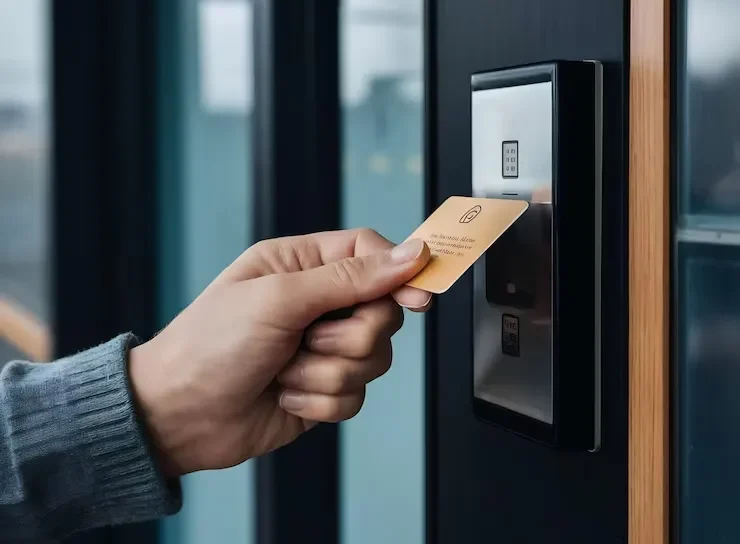
Most corporate integrations rely on one of three credential models, and the right fit depends on tenant size, security posture, and how much wiring the floor already has.
Mobile credentials
Mobile credentials store the access token on a smartphone and authenticate over Bluetooth or NFC at the dispatch panel. They are the strongest option for corporate teams that want touchless elevator access control, since tokens are harder to clone than a card and can be issued or pulled remotely the same day someone joins or leaves.
Card and fob readers
Card and fob readers stay common because they are inexpensive and familiar. The tradeoff is sharing and loss. A misplaced fob can reach restricted floors until someone reports it, and large card deployments often need heavier cabling at each reader.
PIN and keypad entry
Keypads skip physical credentials and suit smaller tenants watching budget. They slow the morning rush, though, since each rider types a code, and shared PINs erode floor-level control over time.
How Mobile Credentials Connect Lobby Turnstiles to Elevators
A unified credential ties the lobby turnstile, the dispatch panel, and the elevator controller together, so one authentication event releases the turnstile and assigns a car bound for an approved floor.
The flow starts at the turnstile, where the reader validates the credential against the access platform. That same event passes the rider’s floor permissions to the dispatch controller, which selects a car and shows the assignment on a screen. The cab then accepts only the cleared floor, with no open button panel to override the rule.
Building this path cleanly is far easier during construction, before walls close and while conduit, low-voltage runs, and panel locations can still be mapped. Planning the new construction IT infrastructure around both the base building risers and the tenant floor avoids costly rework once the space is occupied.
Security Benefits of Floor-Level Access Restrictions
Floor-level restrictions limit each credential to the floors a person needs, which shrinks the area an intruder or former employee can reach inside a multi-tenant tower.
A lobby turnstile alone proves someone belongs in the building, not that they belong on the 14th floor. Tying identity to the elevator adds a second checkpoint between the street and sensitive space such as server rooms, executive suites, or research areas. For regulated tenants in finance or healthcare, that layered control also supports audit requirements, since the platform records who reached which floor and at what time.
Pairing dispatch integration with well-designed commercial access control systems at the suite doors gives security teams a continuous record from entrance to office, rather than scattered logs that are hard to reconcile after an incident. It also narrows the risk window during staff turnover, since one revocation removes a person from the lobby, the elevators, and every interior door at once.
Coordinating Tenant Security with Base-Building Management
Solid integration depends on early coordination between the tenant’s IT and security team and the building’s property management, since both control hardware that the unified credential has to pass through.
Landlords often standardize on a specific elevator and dispatch manufacturer, so the tenant’s access platform has to support that system’s integration protocol. Sorting out compatibility, credential formats, and who administers shared permissions belongs in the planning phase, not after install. Tenants moving onto a new floor should raise these points during lease negotiation and loop in their integrator early, while the base building team still has room to accommodate the connection.
Handled well, the result is one credential that carries an employee from the sidewalk to their desk, with security and daily convenience drawing from the same source.