
- Home
- IT Services
- AI Video Analytics & Intelligent Video Systems
- Savant Home Automation
- Help Desk & Maintenance
- Advanced Networking Security
- Audio Visual Installation
- Moves, Adds and Changes
- Structured Cabling & Networking
- VoIP Installation in NYC
- Smart Home Automation Systems in NYC
- Audio Video NYC
- Media Room & Home Theater Installation in NYC
- Audio Video Structured Cabling NYC
- Security & Surveillance
- New Construction
- Area
- Brooklyn, NY
- Queens, NY
- Home Security Services NYC
- Home Security Services New Jersey
- Manhattan, NY
- Audio Video Downtown Manhattan
- Audio Video Midtown Manhattan
- Audio Video Midtown
- Audio Video Upper East Side
- Audio Video Lower East Side
- Audio Video Uptown Manhattan
- Video Camera Installation in Murray Hill, Manhattan, NY
- Video Camera Installation in Chelsea NY
- IT Help Desk Support Queens, NY
- Home Automation Installation Queens, NY
- VoIP Phone Systems Installation Manhattan, NY
- CCTV Camera Installation Bronx, NY
- Access Control Systems Queens, NY
- Structured Cabling Installation Manhattan, NY
- Network Security Services Brooklyn, NY
- News
- Projects
- Contact
Designing Zoom Rooms for Acoustic Equity in Hybrid Meetings
Most hybrid meeting problems trace back to one thing. The remote person on Zoom hears half a conversation, asks “wait, what did you say?” three times, and gradually stops contributing. The people in the room think the call sounded fine. That gap is what AV engineers call a meeting equity problem, and it has almost nothing to do with internet speed and almost everything to do with what your conference room is made of.
If your team is redesigning a boardroom or trying to fix a space that sounded great until you put a Zoom call in it, the audio side of the project deserves its own attention. Designing Zoom rooms for acoustic equity means treating in-room sound with the same care you give the video feed and the network, so remote participants get the full conversation instead of a muffled, reverby version of it.
What Is Acoustic Equity in a Video Conference?
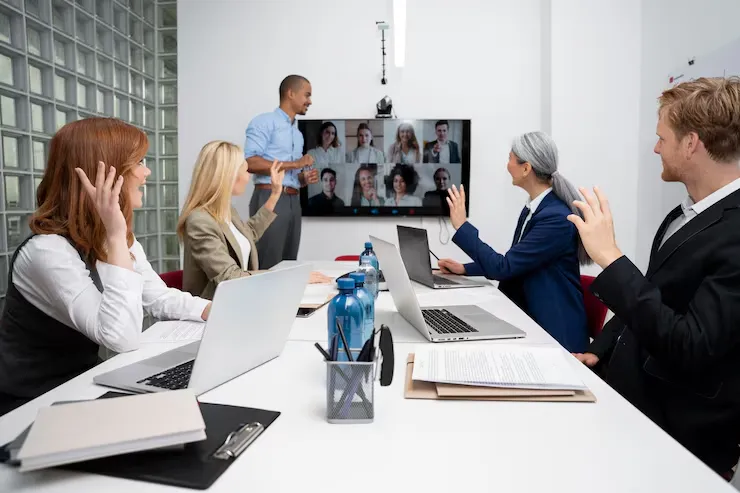
Acoustic equity is the idea that every meeting participant, in the room or dialing in remotely, should hear the conversation with the same clarity. In practical terms, that means picking up every voice at the table evenly, suppressing room reflections, and delivering audio to the far end that sounds close to a one on one call.
The opposite is what most companies live with today. Someone speaks from the head of the table and sounds crisp. Someone else replies from across the room and arrives on Zoom as a distant blur. Remote staff fill in the gaps with guesswork, miss tone, and slowly disengage. Fixing this is partly hardware, partly room treatment, and partly knowing what the space is doing to the sound before it reaches the microphone.
Solving Echo in Exposed Ceiling Brooklyn Tech Offices
Echo problems in trendy NYC offices almost always come from three surfaces working against you. Exposed concrete ceilings, polished concrete or hardwood floors, and large stretches of glass. Sound bounces between all of them, lingers in the air, and feeds into your microphones as a wash of reverb on top of every spoken word.
The acoustic treatment Zoom room exposed ceiling problem shows up constantly in Williamsburg, DUMBO, and Bushwick conversions, where the look is half the lease. Strip out the drop ceiling for that warehouse feel and you remove the single biggest absorber a typical office has. Reverberation times that should land near 0.4 seconds can climb above a full second, which destroys speech intelligibility on the call.
Why the Far End Hears It Worse Than You Do
In person, your brain filters room reflections out automatically and locks onto the speaker. Zoom cannot do that. The microphone captures the direct voice and the reflections together, then compresses them into a single audio stream. What felt lively in the room arrives at the far end as a tinny, smeared signal.
Ceiling Mics, Table Mics, and Soundbars Compared
The right microphone depends on room shape, ceiling height, and how often the room hosts large meetings versus small ones. No single category wins every time, and most well designed rooms end up using whichever option fits the way people sit and talk in that space.
| Microphone Type | Best For | Strengths | Trade Offs |
| Ceiling Array Mics | Boardrooms with 8 or more seats | Clean tabletops, beamforming picks up voices evenly, scales to wide rooms | Higher install cost, needs a flat ceiling, sensitive to HVAC noise above the tile |
| Tabletop Mics | Mid sized rooms with fixed seating | Lower cost, easy to deploy, strong pickup near each speaker | Visible on the table, vulnerable to paper shuffle and laptop typing |
| Soundbars With Built In Mics | Huddle rooms under 10 by 14 feet | All in one unit, fast to install, works for 4 to 6 people | Limited reach, struggles in long rooms, misses anyone past 6 to 8 feet |
Zoom Room Certified Hardware Models Worth Knowing
A few Zoom certified devices show up consistently in NYC commercial installs. For ceiling arrays, the Shure MXA920 and Sennheiser TeamConnect Ceiling 2 cover most large rooms reliably. For tabletop setups, the Logitech Rally Mic Pod and Poly Trio C60 are common picks. Huddle spaces typically run the Logitech Rally Bar, Neat Bar Pro, or Poly Studio X70 as an all in one camera, mic, and speaker unit. Pairing any of these with a stable backbone matters, so it’s worth coordinating with whoever handles your office network setup so the room isn’t fighting the rest of the floor for bandwidth on call days.
How Hardwood Floors and Glass Walls Ruin Meeting Audio
Hard, parallel surfaces create flutter echo, a rapid back and forth reflection that smears speech and feeds straight into your mics. Hardwood floors, glass walls, and bare drywall are the worst combination because none of them absorb meaningful sound energy in the speech frequency range.
If you’ve ever wondered how to fix echo in glass conference room setups without losing the look, the answer is breaking up at least one of the parallel surfaces. Most installers target the ceiling first because it’s the largest reflective plane and the least visible. Floors come next, usually an area rug that doesn’t fight the aesthetic. Glass walls are the hardest to treat, and most teams handle them with acoustic film, fabric wrapped panels at seated head height, or vertical fins set perpendicular to the glass.
Acoustic Treatment Strategies for Modern Boardrooms
The goal is a room with a reverberation time of around 0.4 to 0.6 seconds and a noise floor below 35 dBA. Hit those numbers and your microphones have a real chance, regardless of which video platform runs on top of them.
Effective hybrid meeting audio solutions usually layer three things. Broadband absorbers on the ceiling, either as suspended clouds or a treated tile system, handle the bulk of reverberation. Wall panels behind the primary seating positions catch first reflections off the side walls. A rug or carpet tile zone under the conference table cuts hard floor bounce without converting the whole office to soft flooring.
Working Around Sprinklers and HVAC in NYC Buildings
NYC ceiling treatment runs into two complications fast. Sprinkler heads need clearance per FDNY rules, and HVAC supply registers often land right where you’d want a cloud. Coordinating with the building’s MEP drawings during design saves rework later. Suspended baffles thread between obstacles more easily than full ceiling clouds and perform similarly when sized correctly.
AI Noise Cancellation in Modern AV Hardware
AI noise suppression helps with steady background sound like HVAC hum and keyboard clatter, but it cannot repair a room with bad acoustics. Zoom’s own background noise removal, plus on device DSP in modern soundbars, can clean up minor issues. They cannot undo a room reverberating past a full second.
Treating the space first and letting the AI handle the last ten percent is the right order. Teams that skip room treatment and lean on software cleanup usually end up with audio that sounds processed and slightly underwater once more than one person speaks. If you’re planning a new build out, looping in a Zoom Room installation team during the architectural phase, before finishes get locked in, is the cheapest way to get the audio right.